Padel racket shapes explained: round, teardrop, diamond and what each does to the ball
By the Lobwell Padel team. Updated 1 November 2026.
Short answer: Padel rackets come in three main shapes. Round heads have a low, central sweet spot and a head light balance for control; teardrops lift the sweet spot slightly for a mix of control and power; diamonds put the sweet spot and weight high on the face for power on smashes. Most club players are best served by round or teardrop, with diamond suited to advanced attackers.
Why shape matters more than brand
All three shapes must fit inside the same FIP limits: 45.5 cm long, no wider than 26 cm and no thicker than 38 mm. What changes is how the head's area and mass are distributed within that outline. A wide, round head spreads the hitting area evenly around the middle. A diamond narrows towards the throat and widens near the top, so the useful part of the face moves up. That one change shifts the balance point, the size of the sweet spot and the speed at which the head comes through.
If you only learn one thing about rackets, learn this. Shape tells you more about how a racket will play than its price, its colour or the name on it.
Round
A round head carries its widest point roughly in the middle of the face, so the sweet spot is large and close to your hand. Mishits near the frame still have enough response to get the ball back over. The balance is usually low, which makes the racket feel light even when it is not, and quick to bring back to the ready position at the net.
Round rackets suit beginners, improvers, players who defend from the back and anyone who values control over pace. Many experienced right side players stay with round rackets because they spend more time building points than finishing them. Browse the round padel rackets.

Teardrop
A teardrop is wider near the top and narrows gently towards the throat. The sweet spot sits a little higher than on a round racket, and the balance moves towards even. It is the all rounder: you get more reach and pace on overheads without giving up much forgiveness on volleys and defence.
It is the natural second racket once you are confident off the back glass and play at least twice a week. See teardrop padel rackets.
Diamond
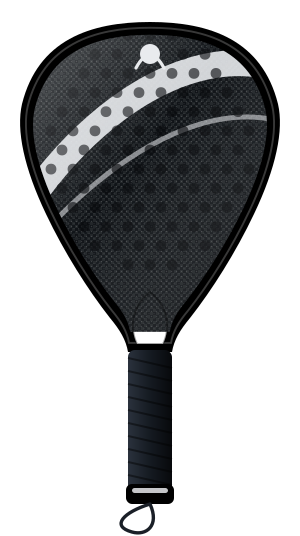
A diamond has a pointed top and its widest part high up the face. The sweet spot sits towards the tip and the balance is high, so more mass is moving at the point of contact on a smash. That is why most attacking left side players use one. The trade-off is a smaller sweet spot, less forgiveness on low balls and more strain on the arm if your technique is not clean. See diamond padel rackets.

The three shapes side by side
| Round | Teardrop | Diamond | |
|---|---|---|---|
| Sweet spot | Large, central | Medium, slightly high | Smaller, high |
| Typical balance | Low (head light) | Even | High (head heavy) |
| Strength | Control and defence | All round | Power on overheads |
| Forgiveness | Highest | Medium | Lowest |
| Typical player | Beginner to improver, right side builder | Improver to intermediate | Advanced, left side finisher |
| Lobwell racket | Fen, Tor, Lark, Pip | Ridge, Arc | Crag |
Shape and where you play on court
In a settled pair, the right side player (the drive side for right handers) plays more balls down the middle and sets up points with steady lobs and low volleys. The left side player takes more overheads in the centre and is usually the one who finishes. That split is why you often see a round or teardrop racket on the right and a diamond on the left in good club pairs.
It is not a rule to copy blindly. If you play with different partners each week in an americano, you will switch sides all the time, and a teardrop that does a bit of everything is the safer pick. Choose the shape for the balls you actually hit most, not the ones you see on highlight reels.
Hybrid and other labels
You will see words like hybrid, elongated or drop shape in product listings. These are marketing labels for variations within the three families. A hybrid usually means a teardrop that leans towards round, or a round head with a slightly higher balance. Rather than trusting the label, look at the stated balance and where the widest part of the face sits. If the widest point is at or below the middle, it will play like a round racket.
Our Ridge, for example, is a teardrop designed for players moving off a round head, so it plays closer to a round racket than Arc does.
Which shape should you buy?
Still not sure? The racket finder asks four questions and picks a shape for you.
- First year of padel, or you play once a week: round.
- You play twice a week, defend well and want more on your overheads: teardrop.
- You are an advanced left side player who finishes points from the net: diamond.
- You have had arm discomfort or prefer comfort: round, and consider a lighter one.
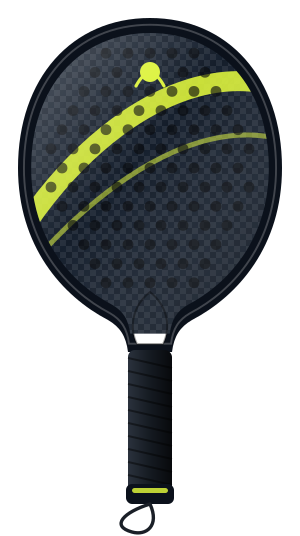
Lobwell Tor
Round 3K carbon racket for your first year and well beyond it
- Round
- 3K carbon
- 355 to 365 g
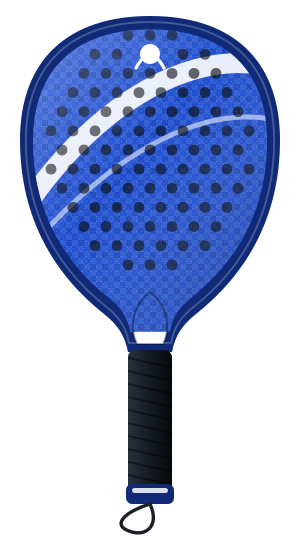
Lobwell Ridge
Teardrop 3K carbon racket for players moving off a round head
- Teardrop
- 3K carbon
- 360 to 370 g
Questions people ask
Which padel racket shape is best for beginners?
Round. It has the biggest and most central sweet spot and a head light balance, so it forgives off-centre hits and is easy to move.
Is a teardrop racket good for intermediate players?
Yes. A teardrop is the most common choice for intermediate players because it adds pace on overheads while keeping a reasonable sweet spot.
Why do pros use diamond rackets?
Many attacking players use diamonds because the high balance adds momentum on smashes. Plenty of professionals still use round or teardrop rackets, especially defensive players.
Does racket shape affect spin?
Only a little. Spin comes mostly from your swing and the face finish. A rough surface helps the ball grip more than any shape does.
Sources
Keep reading
 ComparisonRound vs teardrop vs diamond: which padel racket shape wins, shot by shotRound rackets win on control, forgiveness and speed at the net; diamond rackets win on overhead power; teardrops sit in between and are the most common choice for intermediate players.
 GuidePadel racket balance: head light, even or head heavy, and how it changes your gameBalance is where a padel racket's weight sits along its length.
 GuideHow to choose a padel racket: shape, weight, core and face in six decisionsChoose a padel racket by your level first, then shape, weight and core.
 Buying guideThe best padel rackets for power: the specs behind a heavy smash, and who should use themA power padel racket combines a diamond or high teardrop head, a high (head heavy) balance, a hard EVA core and a stiff 12K or 18K carbon face, usually at 365 to 375 g.
Buying guideThe best padel rackets for control: specs for defenders, builders and right side playersA control padel racket has a round head, a low (head light) balance, a soft to medium EVA core and a 3K carbon or glass fibre face, usually at 340 to 365 g.