Padel court size: every dimension in metres, from the net to the roof
By the Lobwell Padel team. Updated 1 November 2026.
Short answer: A padel court is 10 metres wide and 20 metres long, measured inside the walls, with a 0.5% tolerance. The net is 0.88 m high in the centre and 0.92 m at the ends, the service lines sit 6.95 m from the net, and the back walls are 4 m high (3 m of glass topped with 1 m of mesh). Indoor courts need at least 6 m of clear height, and the FIP recommends 8 m for new builds.

The playing area
The FIP defines the court as a rectangle 10 metres wide by 20 metres long, inside measurements, with a tolerance of 0.5%. That gives 200 square metres of playing surface. A tennis doubles court is 23.77 by 10.97 metres, so a padel court is just over a third of its area once you count only the lines. In practice a padel court with its surround needs a plot of roughly 11 by 21 metres, and three padel courts can often replace one tennis court and its run off.
The net divides the court into two 10 by 10 metre halves. Each half has a service line parallel to the net and a centre line splitting the area between net and service line into two service boxes.
| Part | Measurement |
|---|---|
| Length (inside) | 20 m |
| Width (inside) | 10 m |
| Tolerance | 0.5% |
| Service line from the net | 6.95 m |
| Service box | 6.95 m deep by 5 m wide |
| Service line to back wall | 3.05 m |
| Line width | 5 cm |
| Net length | 10 m |
| Net height | 0.88 m centre, 0.92 m at the ends |
| Net posts | 1.05 m maximum |
The walls and mesh
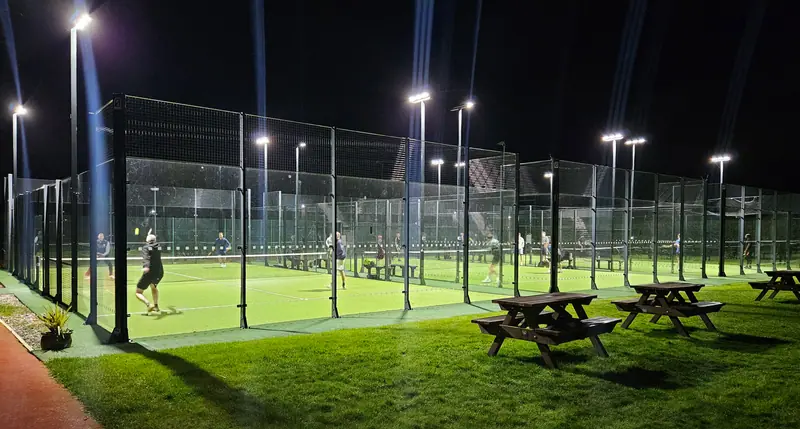
The walls are what make padel. At each end there is a back wall 4 metres high: the bottom 3 metres is glass or solid wall, and the top metre is metal mesh. Along the sides, the FIP allows two layouts. In the stepped version, the side wall runs 3 metres high for the first 2 metres from the back, then 2 metres high for the next 2 metres. In the crystal version, there is a 3 metre high by 4 metre long panel at each end. Mesh fills the rest, rising to 3 metres in the middle of the court and 4 metres at the ends.
The ball behaves differently on each surface. Glass gives a true, predictable rebound. Mesh gives a dead, unpredictable one. Learning which you are about to hit is part of the game, covered in playing off the walls.
Height above the court
Lobs are a core shot, so indoor courts need height. The FIP minimum is 6 metres of clear space above the whole court with nothing hanging into it, and 8 metres is recommended for new facilities. Some converted UK warehouses and older sports halls fall at the low end of that range, and you will notice: a high defensive lob clips the roof and the point is lost. If you play mostly indoors in a low hall, a flatter, faster lob becomes your main defensive shot.
Padel court size compared with tennis, pickleball and squash
People often ask how a padel court compares with the courts they already know. The table uses each sport's published dimensions. Padel is far bigger than a squash court but much smaller than tennis, which is why it suits players who find tennis running hard work. See padel vs tennis and padel vs squash for how the size changes the game.
| Sport | Length | Width | Area |
|---|---|---|---|
| Padel | 20 m | 10 m | 200 square metres |
| Tennis (doubles lines) | 23.77 m | 10.97 m | about 261 square metres |
| Pickleball | 13.4 m | 6.1 m | about 82 square metres |
| Squash | 9.75 m | 6.4 m | about 62 square metres |
Surface and lighting
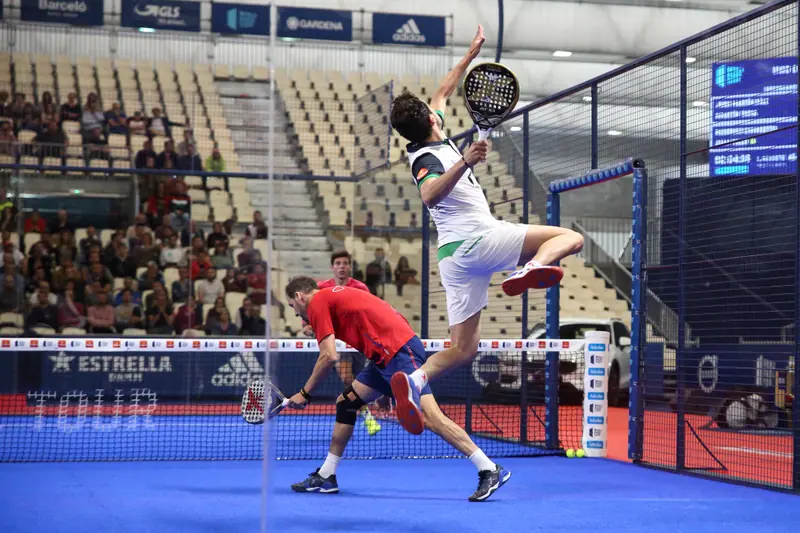
Most UK courts use sand filled artificial grass, which is laid on a porous base outdoors and on concrete indoors. The sand gives grip but also slides under shoes with a flat or running sole, which is why padel shoes use a herringbone pattern. Our padel shoes guide explains the sole types. Indoor courts are usually lit from the sides so lights do not shine straight down into a player's eyes on a lob.
Turf colour does not change play, but older, worn turf with little sand makes the ball skid lower. If your local court plays fast, a softer racket gives you more time.
Can you build one at home?
A full size court needs that 11 by 21 metre plot, a level, drained base, and 4 metre walls, so it is a big project. Most players in the UK use one of the 916 venues we found across the country instead. Our padel court finder lists them by town, with indoor and outdoor details, and the court price index shows what hiring one costs.
Lobwell Grip Padel Shoe
Herringbone sole court shoe for sand filled artificial grass
- Lobwell
- 2 colours
Lobwell Tor
Round 3K carbon racket for your first year and well beyond it
- Round
- 3K carbon
- 355 to 365 g
Questions people ask
How big is a padel court in metres?
The playing area is 10 metres wide by 20 metres long, measured inside the walls.
How high is a padel net?
0.88 metres in the centre, rising to 0.92 metres at the ends. That is slightly lower than a tennis net, which is 0.914 metres in the centre.
How far is the service line from the net?
6.95 metres, which leaves 3.05 metres between the service line and the back glass.
How many padel courts fit on a tennis court?
Clubs commonly fit two or three padel courts in the space of one tennis court with its surround, depending on the run off and fencing.
Sources
Keep reading
 GuidePadel rules: every rule you need for doubles, from the serve to the fencePadel rules come from the International Padel Federation.
 GuidePlaying off the walls: how to read the back and side glass in padelTo play off the back glass in padel, turn sideways early, let the ball pass you, move with it towards the wall and hit it as it comes back off the glass, usually upwards into a lob or a low ball to the middle.
 ComparisonPadel vs tennis: the court, racket, ball, rules and cost comparedPadel is played on a walled 20 by 10 metre court, almost always as doubles, with a solid stringless racket, a slightly smaller, lower pressure ball and an underarm serve; the ball can be played off the glass.
ComparisonPadel vs squash: walls, courts, intensity and which suits youBoth sports use walls, but very differently.
 ComparisonPadel vs pickleball: two fast growing sports with very different courtsPadel is played on an enclosed 20 by 10 metre court with glass walls you can use, a perforated foam core racket and a pressurised felt ball.